


Under the Oracle of Delphi’s guidance, the legendary founder of Thebes, Cadmus, founded the city of Thebes.
Thebes is one of the oldest continuously inhabited cities in the world and the third oldest in Europe. First inhabited around 3000 BCE, Thebes has a rich history and played an important role in the development of Greece.
Archaeological excavations in and around Thebes have revealed a Mycenaean settlement and clay tablets written in the Linear B script, indicating the importance of the site in the Bronze Age.
Thebes was the largest city of the ancient region of Boeotia and was the leader of the Boeotian confederacy. It was a major rival of ancient Athens, and sided with the Persians during the 480 BC invasion under Xerxes I. Theban forces under the command of Epaminondas ended Spartan hegemony at the Battle of Leuctra in 371 BC, with the Sacred Band of Thebes, an elite military unit of male lovers celebrated as instrumental there.
Macedonia would rise in power at the Battle of Chaeronea in 338 BC, bringing decisive victory to Philip II over an alliance of Thebes and Athens. Thebes was a major force in Greek history prior to its destruction by Alexander the Great in 335 BC, and was the most dominant city-state at the time of the Macedonian conquest of Greece. During the Byzantine period, the city was famous for its silks.
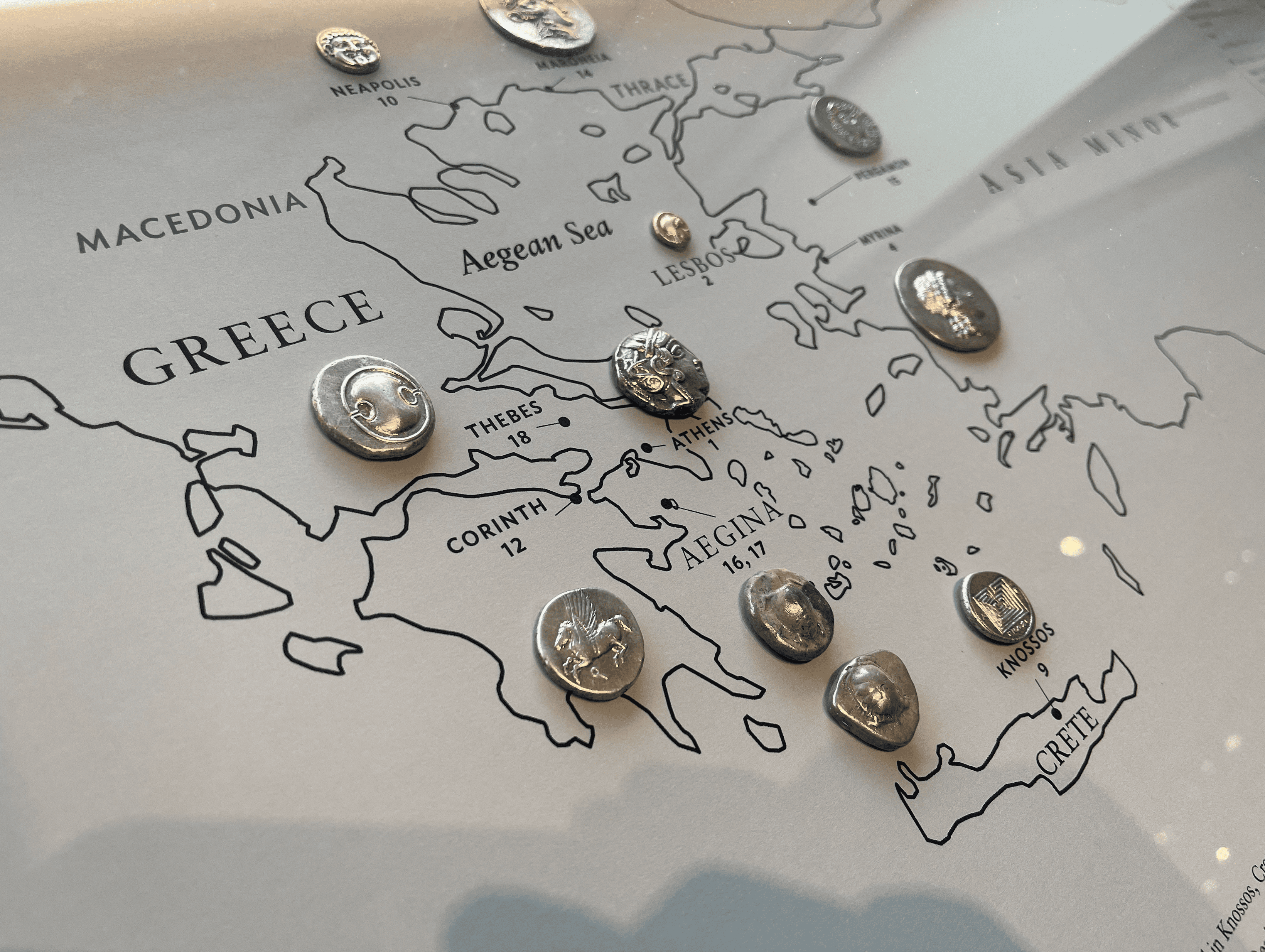
The Art Institute of Chicago
18. Stater (Coin) Depicting a Shield
The distinctive shield shown on this coin was particular to the Theban army. It remained a symbol of the city for centuries until 335 BC, when the city was razed for opposing Alexander the Great.